Social Work in a Changing World – Reflections from Scotland

Cover picture: Dunnottar Castle in Stonehaven, outside Aberdeen
In Aberdeen, where granite meets the sea and history meets the present, 800 social workers and researchers gathered for a few days in April to attend the European Conference for Social Work Research (ECSWR 2026). The city, often referred to as the Granite City, is known for its light grey granite buildings, which give the urban environment a distinctive and cohesive character. Beyond the city centre, the historical landscape continues, with several castles leaving a strong imprint on the Scottish countryside. In this setting, participants from across Europe came together around the theme Social Work and Interdisciplinary Research. As doctoral students, we were given the opportunity to participate and contribute to the conference discussions on the future of social work.
Keynote Speakers and Conference Content
The conference featured several inspiring keynote speakers who, in different ways, highlighted how social work can develop through interdisciplinary research, collaboration, and evidence-based practice. The lectures addressed both structural societal challenges and professional issues closely linked to practice.
In his keynote address, Vasilios Ioakimidis emphasized the importance of viewing social work from a historical and comparative perspective. He argued that the profession cannot be understood without considering the societal and historical contexts that have shaped both welfare systems and people’s living conditions. By looking beyond individual-focused narratives, it becomes possible to identify patterns of power, exclusion, and resistance, thus reaffirming the critical and transformative mission of social work.
Carlene Firmin’s keynote shared several points of connection with Ioakimidis’ perspective, as she presented concrete examples of young people’s exposure to violence in social environments outside the home, such as schools and peer groups. Firmin has developed the concept of Contextual Safeguarding, which focuses on improving protection for young people by directing interventions toward the contexts in which risks arise.

The conference centre was located 30 minutes (by bus) outside central Aberdeen
Workshops and our own research contributions
In addition to the main keynote lectures, the conference also provided opportunities for deeper engagement through workshops and parallel sessions. We listened to researchers presenting current studies with a particular focus on children, families, and service systems; research involving clients as co-researchers; and the opportunities and risks associated with artificial intelligence in social work practice. The workshop presentations demonstrated both theoretical developments and concrete examples from various European contexts.
One particularly interesting symposium addressed Sense and Sensibility in Social Work with Children and Families. The symposium was based on the book Sense and Sensibility in Social Work with Families and Children , edited by Serbati, Marthinsen, and Featherstone. During the workshop, the authors discussed the importance of combining professional knowledge and judgment (sense) with responsiveness, relationships, and participation (sensibility) in work with children and families. The event also gave us the opportunity to establish contacts with other universities and higher education institutions in the Nordic countries and across Europe.
We also presented our own research, partly connected to Novia: “Negotiating Child Participation in Finnish Child Welfare Services: Insights from a Client Perspective” and “Language Barriers in Child Welfare: The Experiences of Young People with Migrant and Minority-Language Backgrounds in Finland.” The former was a collaboration between the Svenska social och kommunalhögskolan, the University of Helsinki, and Åbo Akademi, while the latter was a collaboration between Åbo Akademi and the University of Helsinki.
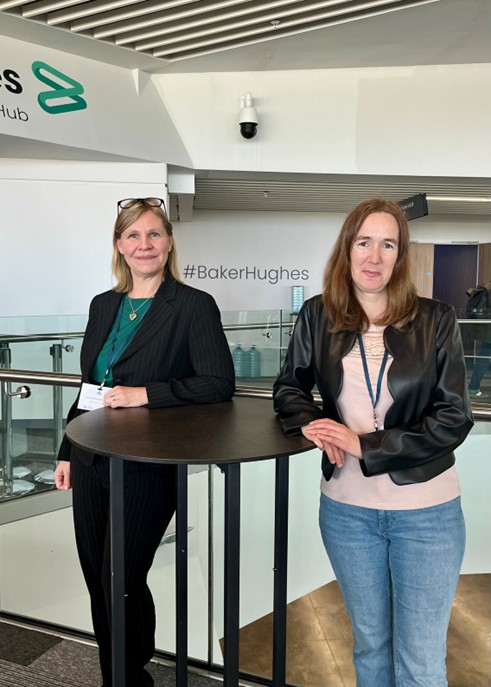
Johanna Wikgren-Roelofs and Ann Backman at the ECSWR 2026 conference in Scotland
Reflections and concluding thoughts
Aberdeen is known as a city where one can experience all four seasons in a single day, something that was clearly noticeable as the weather shifted rapidly between sunshine, wind, and rain. This is an apt metaphor for a conference that reflected the complexity and ongoing transformation of social work. At the same time, issues related to technology, artificial intelligence, and increasing loneliness repeatedly emerged as themes reshaping the conditions for social work, raising ethical and professional reflections, and opening up new ways of working and collaborating.
Overall, the conference in Aberdeen was both inspiring and thought-provoking, providing us with new perspectives, valuable contacts, and deeper insights for our continued research and development work within the social welfare at Novia.
(Ann’s conference trip was partly funded within the framework of doctoral studies at the University of Helsinki and with support from the Swedish Cultural Foundation. Johanna’s trip was funded within the framework of the LIVICS project at Åbo Akademi.)
Reseskildringen har godkänts för publicering av Novias redaktionsråd 6.5.2026.
ISSN: 2670-028X