Erasmus-BIP Program Experience at Landshut University of Applied Sciences

In October 2025, Landshut University of Applied Sciences hosted an Erasmus-BIP (Blended Intensive Program) called LA ideation week, that brought together students and teachers from across Europe and beyond. The format of this program truly lived up to its name, i.e. intensive. Participants spent an entire week immersed in both work and social activities in the scenic city of Landshut. Days began early and extended late into the night, resulting in a tiring, yet fulfilling experience, filled with new acquaintances, innovative ideas, and lasting impressions.
Formation of Groups and Ice-Breaking Activities
The first day commenced with introductions at the hotel, where participants had the opportunity to meet one another. The 32 students, representing seven different countries—Germany, Croatia, Spain, Finland, Denmark, Lithuania, and Mexico—were divided into eight groups. To ease initial interactions, the first group task was to guess three things about each other, serving as an effective icebreaker. Besides business, the participants also studied engineering and informatics, leading to increased diversity in the groups.
The student groups were joined by eight teachers from five countries, where the two authors represented Novia UAS. Besides three teachers from Landshut, the other teachers were from University of Lleida in Spain, University of Split in Croatia and VIA University College in Denmark.
The challenge – Ideation and Pitching
Following the initial activities, we relocated to Landshut University for lunch and a session focused on theoretical input, which set the stage for the core of the course: group ideation work. Each group was challenged to develop a business idea, suitable for the European market, and to prepare a pitch for pre-seed stage investors. During the theory session, particular emphasis was placed on identifying a relevant problem to address—a task that soon proved to be more challenging than anticipated. However, after the first day of brainstorming and voting between different ideas, all groups had agreed on an idea to develop further during the coming days (even if some groups made a pivot the next morning and changed their ideas).
The following days were, apart from short theory inputs by Professor Bernd Mühlfriedel from Landshut University, characterized by field research, prototyping and finally, developing and presenting a pitch to a group of “seed investors”, i.e. the coaches who formed the jury. During the week, the coaches rotated between the groups and guided them with the assignment, by asking questions and providing some tools and guidelines. Each group had ten minutes to pitch the problem, the solution, the customer, market, competition, and business model. The winning group, ConstraLoop, presented the idea of a platform for selling left-over construction materials. The other ideas varied from apps related to food allergies, safety, and connecting students with each other to care for the elderly and making waste management easier for households.
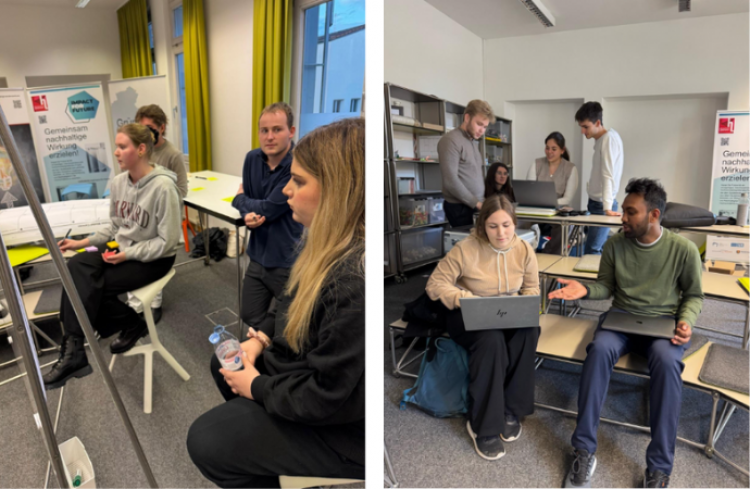
Group ideation work in progress.
Business Visits and Extracurricular Activities
In addition to the ideation and business model development, we had the opportunity to visit several businesses in the region. On the first day we visited Hive MQ, a platform designed for MQTT (Message Queuing Telemetry Transport), primarily used in IoT (Internet of Things). We were given a tour around their office, with several nice spots for employees to use for other purposes than working, such as a piano, ping pong table and yoga room, free soft drinks etc. Hive MQ emphasized that a company that cannot offer the highest salaries needs to create a culture, where employees feel appreciated. Afterwards we had what was probably the world’s biggest schnitzel in a nearby restaurant, leaving us to think about food waste, as it was almost impossible to finish it.
The following day we were shown around the premises of ASIS Gmbh, a family-owned automation company. Besides the official company presentation and factory tour, we learned about their unique company culture, through a nice evening at their office, including some food and drinks and music by the house band. The band rehearsed every Tuesday and consisted of the company owner on the saxophone, the managing director on the base, his wife, the CFO, singing together with the HR responsible, and with the technical director playing drums. The secretary played keyboards, and a trainee played the guitar. We were left with the sensation of having been part of a family, rather than visiting a company.
On Wednesday we were escorted by bus to a nearby city, Regensburg, where we were, in addition to a walking city tour, acquainted with a start-up factory, Maker Space OTH. The building hosted several different spaces for start-up meetings, as well as workshop equipment, such as 3-D printers, sewing machines, and other tools for building different prototypes of products.
Thursday’s company visit was a highlight for many of us, as we visited MiniTube, a family-owned world leading supplier of systems for assisting animal reproduction. A very interesting business few of us had thought about before!
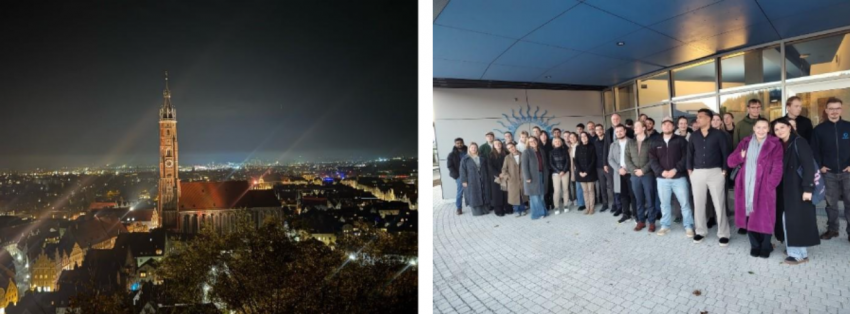
Extracurricular activities.
The last day, Friday, ended with a gala dinner at the Trausnitz, a medieval castle on the highest point of the city. After climbing several stairs, we were treated to a tasty dinner and a spectacular view of Landshut. The students received their course certificates, and the awards for the winners were presented. A great night to end a great week!
Lessons learned
What did we take with us from this intensive week? We learned how important it is to provide opportunities for our students to step out of their comfort zone, to interact with students from other countries, cultures and disciplines, and to be creative together. It was a delight to watch them work together, overcoming any initial obstacles and helping each other succeed. All the groups were ambitious, focused, and worked hard, yet managed to have fun together. As one of our students put it: “
”One of the most inspiring aspects of the BIP was the diversity within the teams. Working with students from Croatia, Denmark, Mexico, and several other countries brought not only different professional and academic backgrounds but also a wide range of cultural perspectives. It became evident very quickly that innovation thrives in diversity. Discussions were richer, brainstorming sessions more dynamic, and every idea was shaped by influences none of us could have brought alone.”
For us teachers, BIP-courses provide a platform for meeting and connecting with teachers from other universities and countries. During the week we had many interesting discussions regarding the way of working in our universities, we planned teacher exchanges and a follow-up BIP-course in Spain. The other teachers, as well as the students, expressed great interest in the team learning of Novia UAS, and many voiced an interest in coming and seeing it for themselves.
For future BIP courses, it is important to leave some room for the social part, enabling the students to interact with each other, also between their work groups. The program in Landshut was a bit too ambitious in that it did not allow for any free time, leaving some of the students (and teachers) quite exhausted. On the other hand, the company visits provided added value to the course and gave the students and teachers insights into different industries and business models. It is important to consider the workload for the students for future BIP courses.
We were left with the feeling of having had a rough but great week, resulting in new ideas and contacts, which will surely be useful in the future. Vielen Dank, Landshut!
Reseskildringen har godkänts för publicering av Novias redaktionsråd 5.12.2025.
ISSN: 2670-028X
