Beyond Teams Meetings: Erasmus Exchange as a Pathway to Global Competence and Living Labs

Introduction
This Erasmus Staff Exchange had a threefold purpose. First, it aimed to provide insights into how students’ global mindset is developed and monitored at Hotel Management School Maastricht (HMSM), Zuyd University of Applied Sciences, with a focus on identifying effective pedagogical approaches and assessment practices. Second, the exchange offered an opportunity to learn more about the Living Lab concept at Inholland University of Applied Sciences and to explore how this practice-oriented approach can support innovation, collaboration, and real-world learning. Third, the exchange sought to deepen understanding of urban regenerative tourism, with particular attention to how tourism can contribute positively to the renewal and long-term sustainability of urban environments. Together, these three dimensions made the exchange a valuable opportunity for professional learning, institutional development, and future collaboration.
The first stop was at Hotel Management School Maastricht (HMSM), where Professor Ankie Hoefnagels, Head of the Research Centre Professional Minds@Work, hosted us. Novia is in the process of developing global competence among staff and students and HMSM was of interest for us, since the school monitors the development of students’ global competence with the help of a Global Mind Monitor (GMM), https://gmm.international/gmm-home-en, which is a tool for students to measure and improve their international competences.
How HMSM develops students’ global mindset
HMSM treats global mindset development as a core part of hospitality education, not as an extra add-on and that can be considered one of the main strengths. The school emphasizes that hospitality professionals need to understand, empathize with, and work effectively with people from different cultural backgrounds, so global competence is systematically integrated into the curriculum and monitored.
It is mandatory for students to live on campus during their first year of study to become part of the campus community, where they regularly interact with peers, staff, hotel guests, and colleagues from different countries. This everyday exposure helps them see different perspectives and become more comfortable in culturally diverse settings.
A major part of global mindset development comes from international experiences. Students complete an operational internship abroad or participate in an exchange semester. It is also possible to do a management internship with an international orientation in the fourth year.
These experiences are designed to help students build language skills, adapt to other cultures, and prepare for international careers in hospitality.
The bachelor’s programme combines theory with practice and includes small-scale, project-based learning, practical hotel work, events, and real-life business cases. Within this structure, students develop not only business and leadership skills but also the ability to operate in international and intercultural contexts. The school explicitly states that global competence is embedded in the education because the hospitality industry itself is international and diverse.
Reflection and assessment of intercultural growth
The research centre, Global Minds @ Work, supports this work by developing tools and teaching methods for intercultural learning. One important tool is the Global Mind Monitor, which helps students assess and reflect on their intercultural competence over time. It measures areas such as multicultural personality, cultural intelligence, ethnocentrism, language skills, and the impact of internationalisation activities. Students are exposed to the GMM four times during their studies, and the result of the monitoring is used as a base for discussions between the student and the teacher tutor. Regular student workshops are arranged before and after internships/exchanges to reflect on critical incidents and pre- and post-cultural scenarios.
The school does not rely only on student mobility. Through Global Minds @ Work, it also invests in applied research, curriculum development, teacher training, and collaboration with industry stakeholders. Developing a global mindset is approached systematically and evidence-based, rather than informally.
Finally, the school also links global competence to broader goals such as inclusive thinking, collective well-being, and sustainable development. Their global mindset approach is, therefore, not only about working internationally, but also about becoming a responsible professional who can respond to social and environmental challenges.
Adapting the above to a Novia context
A natural next step for Novia to develop work on global competence could be to embed global competence learning outcomes across courses, rather than only in specific courses focusing on international issues, and by making intercultural communication, inclusion, and sustainability visible in course objectives, hence ensuring that students reflect on global and local responsibilities in their professional field.
It would also be important to introduce a tool or framework for students to self-assess intercultural competence at different stages of their studies. Suggestions on how to do this could be by using reflection diaries, portfolios, or guided assessments before and after exchanges, internships, or in multicultural group work.
The work on creating more intentional opportunities for interaction between local and international students, designing activities where students work across cultures in meaningful ways, where informal intercultural learning through mentoring, events, and mixed student teams needs to be continued and deepened.
Due to the diversity of degree programs at Novia, framing global competence as part of being a responsible professional, where connecting intercultural learning with sustainability, ethics, and social responsibility would help students understand how global awareness supports responses to environmental and societal challenges.
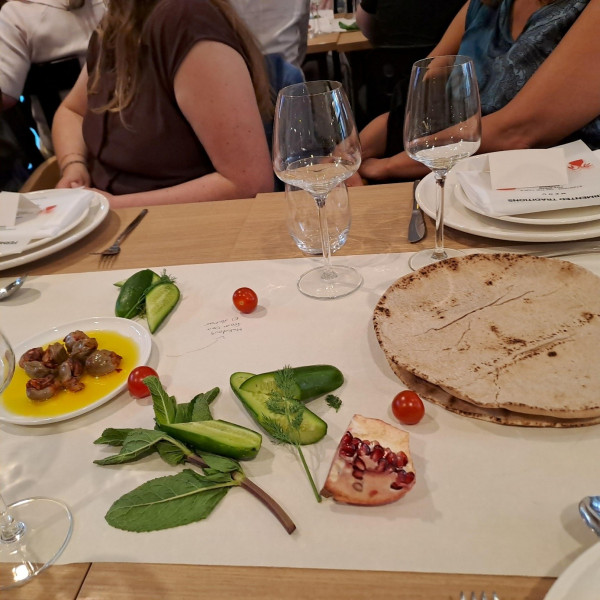
This connection became especially visible during our participation in Breaking the Bread: Fermented Traditions, an evening that celebrated the Lebanese heritage of Mouneh.
Introducing guests to the traditional practice of preserving seasonal food in jars, the event offered more than a culinary experience—it opened a window into values of resilience, care, sustainability, and intergenerational community. Through shared stories, tastes, and traditions, participants were invited to explore how all traditional dishes can carry memory, identity, and belonging across time. For us, the event became the cherry on top of an interesting and rewarding visit at HMSM.
Living Labs
Our visit to InHolland UAS’s Urban Leisure and Tourism Lab in Rotterdam gave us the opportunity to learn about the Living Lab concept followed by a visit to their Living Lab in Amsterdam-Noord. The Living Labs of InHolland are part of the European Network of Living Labs (ENoLL), an international, non-profit, independent association of certified Living Labs. InHolland UAS has a long experience working with the Living Lab concept and our host, associate professor Roos Gerritsa, is one of the leading experts in Holland.
Living Labs are open innovation ecosystems where teaching and learning and research takes place in real-life settings with active involvement of end-users and citizens. In Living Labs a systematic co-creation approach is applied, where citizens and end-users are at the centre. Through co-creation together with students and researchers, the aim is to find solutions that are both innovative and grounded in real needs. This makes Living Labs especially effective for tackling complex societal challenges by integrating diverse perspectives and adapting to change.
According to ENoLL, Living Labs are defined as “user-centred, open innovation ecosystems based on a systematic user co-creation approach, integrating research and innovation processes in real-life communities and settings.”
Learning in a living lab is described by Learning Director ULT. Zac Woolfit “Knowing what to do when you don’t know what to do”.
Our hosts’ descriptions of how students are involved in Living Lab assignments, how this is linked to RDI, and how collaboration with society is used to find solutions, gave us insight into the potential for applying similar approaches and concept at Novia.
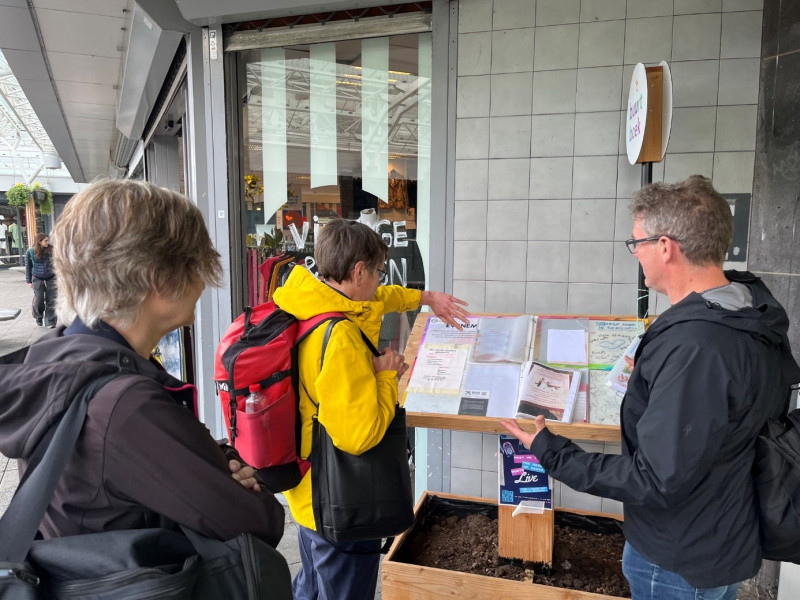
InHolland UAS develops New Urban Tourism as an integral part of the urban environment and regenerative tourism is not only to reduce harm, but to ensure that tourism actively improves places for local communities, local businesses, and nature. It was very interesting to get an insight into how work with regenerative tourism in an urban setting can be developed.
InHolland UAS sees tourism as a tool for urban regeneration and the work is closely linked to placemaking and broader urban transitions. Tourism is used as a pathway to improve public space, support local wellbeing, strengthen social cohesion, and contribute to liveability in neighbourhoods - especially in areas going through change, such as Amsterdam-Noord. By developing local interventions together with stakeholders, InHolland UAS strives to be part of a long-term development, where Amsterdam-Noord in the future will be the new tourism centre of Amsterdam.
Examples mentioned in our discussions with Roos Gerritsa and Zac Woolfit included tours, a story bench, evening markets, projections in the neighbourhood, and other placemaking activities. These are meant to strengthen inclusion, mutual understanding, neighbourhood identity, and social connection.
Since the Novia Business RDI had a tourism research group for regenerative tourism, it was of utmost interest for us to learn how InHolland UAS works on this delicate concept and how they successfully have implemented RDI with education and the urban environment.
Conclusion
The Erasmus exchange offered valuable insights into how global competence, Living Labs, and regenerative tourism can be developed through intentional collaboration between education, research, and society. The visits to HMSM and Inholland UAS highlighted the importance of structured reflection, real-life learning environments, and long-term partnerships in preparing students for complex global and local challenges. For Novia, the exchange opened new ideas for strengthening internationalisation, embedding global competence across curricula, and further developing practice-based approaches that support sustainability, inclusion, and meaningful societal impact.
The first steps in continuing the process of implementing the above at Novia, will be to arrange internal meetings with key persons to share information and discuss the possibilities further.
References
European Networks of Living Labs (ENoLL) https://www.thuas.com/research/centre-expertise/european-network-living-labs-enoll
Hotel Management School Maastricht, Global Minds @ Work https://www.hotelschoolmaastricht.nl/en/research/global-minds-at-work
Learning in a Living Lab https://www.inholland.nl/onderzoek/publicaties/learning-in-a-living-lab/
Reseskildringen har godkänts för publicering av Novias redaktionsråd 1.9.2026.
ISSN: 2670-028X