
Autumn Study Trip to Stockholm, 23–26 November 2025

Introduction:
Third-year bachelor-, master business administration students and teachers from faculty of business at Novia UAS carried out a study trip to Stockholm on 23–26 November 2025. The initiary for the study trip was full of engaging activities and including visits to six different companies as well as the Finnish-Swedish Chamber of Commerce and the Embassy of Finland in Stockholm. Thanks to the support from the Evald and Hilda Nissi Foundation, this study trip was made possible.
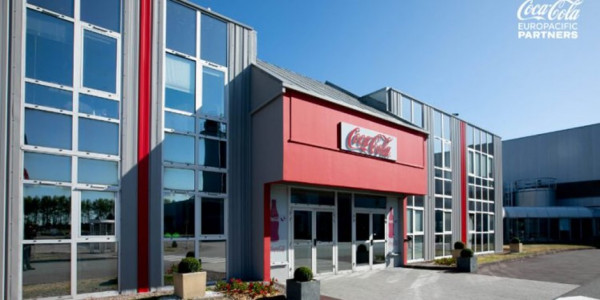
As part of our four-day Stockholm excursion our group of about 50 students from Novia had the opportunity to visit companies from very different branches. The first day was planned around a trip to Coca-Cola Europacific Partners (CCEP) in Jordbro, which also is the main supplier for brands like Fanta, Sprite and Monster. They are part of the Coca-Cola Systems, meaning that they carry out the business under a license from the Coca-Cola Company and conduct their sales and production for the Swedish market.
Picture credit: CCEP
About CCEP:
Upon arrival, the facility’s branding and atmosphere closely resembled that of Coca-Cola itself, big logo, bottles everywhere. However, it was Coca-Cola Europacific Partners (CCEP), the bottling company. They don’t know the recipe and only get the concentrate and take care of mixing, bottling, and delivering the drinks. We learned that the Coca-Cola Company works with different bottlers around the world and each bottler focuses on its specific region. Together, these bottlers cover the whole world. CCEP has market shares on soft drinks in 31 countries and has around 41,000 employees. However, Finland’s market is supplied by another Coca-Cola bottler named Sinebrychoff Oy[1].
Presentation:
Before the actual tour started, we got a presentation that focused on the brand itself, the bottling system and sustainability. They explained what their main responsibilities are and what they are doing to make their operations more sustainable. They also pointed out that in a way, everything starts with the bottle, because it has such a high recognition value all over the world.
Ownership Structure & Corporate Culture:
Another interesting aspect during the presentation was the ownership structure of Coca-Cola Europacific Partners. While The Coca-Cola company is in hands of big institutional Investors, like Berkshire Hathaway (around 9% and the biggest shareholder), the structure for CCEP is completely different. The Daurella family from Barcelona owns, though its holding company, 36% of CCEP. Coca-Cola itself only holds 17% of the shares and the rest is in free flow. This structure makes it possible to lead more independently, since only two shareholders hold the majority of the shares, which they also pointed out during the presentation. According to Sara Wagrowski, Head of Legal Sweden, this has a huge impact on leadership and culture of the company. In comparison to other companies, the culture is way more familiar and therefore based on relationships between employees. Having a significant shareholder who can make independent decisions also makes projects easier to manage[2].
Global Collaboration & Sustainability:
One question that came up during the presentation was whether CCEP also tries to adapt ideas worldwide across the Coca-Cola Systems, when they develop ideas for a more sustainable future. They answered that there is a central team on higher corporate level that brings the bottlers closer, shares ideas, and makes sure that innovative solutions can be spread across different countries.
Legal Department & Regulatory Challenges:
Another interesting part of the presentation was the legal side of the company. We were surprised how many requirements exist and how much work is involved to make sure everything follows regulations. If someone thinks about legal work in a company one could imagine that they must deal mostly with lawsuits, but it is much more complex, because this is only a part of legal departments. For instance, regulations in different countries and finance are more likely part of daily business. Surprisingly, after a question of one of the students, they said, that they try to do as much as possible on their own, but also sometimes need help from outside legal counsels. Especially if we are talking about lawsuits, sometimes it is inevitable to get a specialized law firm. Oftentimes they might also represent on court, even though the company would have people for that in their own company. To help us understand how important the legal department is, they gave us a case study about the EU single market and territorial supply constraints. We had to think about how stricter EU rules could create challenges for local markets such as the Jordbro site, and how these rules might affect their daily operations. One of the aspects were that the restrictions could result in a great amount of work to fulfil and control the new laws for actors on the local market, but at the same time also increase the movement on certain goods.
Picture credit: CCEP
Tour through production
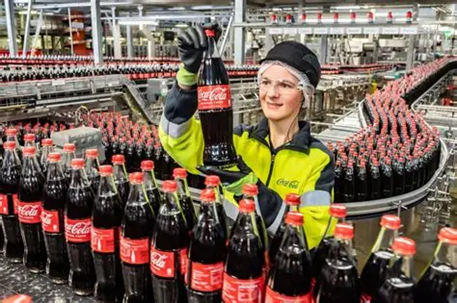
Walking through the warehouse was one of the most exciting moments of the visit. The building is so large that we actually walked on bridges above the storage area, which also gave us a better view of the scale. They explained to us that the warehouse alone is the size of eleven football fields, which helped a lot to understand how massive their logistics really are. Even though their warehouse is that big, they would empty it in just two weeks, if they stopped reproducing. After looking at the storage, we moved on to the production area. There, thousands of bottles were moving across the lines every hour, and it was easy to see how fast and automated the whole process is. In total the facility can produce 1.5 million liters of CCEP products – cans and bottles combined – in only one day. To put this into perspective, Sweden's entire population consumes approximately 2.8 million liters of soft drinks per day, meaning this single facility could cover over half of the country's daily demand. A fun detail was that the production lines originate from Rosenheim, the same city as two of our current exchange students, which made the experience even more special.
Conclusion:
In summary, we took away three key insights: the impact of ownership structure on corporate culture, the complexity of legal work in multinational companies, and the impressive scale of modern beverage production. We want to thank CCEP for their hospitality and for making our trip to Stockholm even more memorable.
References:
[1] Coca-Cola (online) https://www.coca-cola.com/fi/fi
[2] Marketscreener (online) https://de.marketscreener.com/kurs/aktie/COCA-COLA-EUROPACIFIC-PAR-28376817/unternehmen-aktionare/