
Protracted disputes in the north: Visualizing land use conflicts between reindeer herding and forestry in Upper Lapland.

Picture: 1 "The back of a reindeer in the middle of the road" 8.12.2019 by Hanas Roberto, downloaded from https://unsplash.com/photos/black-deer-0ca-fKoUZQE
Reindeer herding and forestry: a historical perspective
Land use conflicts between reindeer herding and forestry in Finland date back to the 1890s. However, they started taking their current shape after the Second World War, as pressure on common lands increased because of modern industrialized forestry methods and a greater number of reindeer. Underlying reasons for the conflict are due to the way the two livelihoods affect the shared landscape they use and due to disputes of land ownership and governance. Clearcutting of forest, building of infrastructure and associated activities by the forestry industry destroy or fragment older forest areas that harbour lichen, the main nutrition to pasturing reindeer. Reindeer require large areas for pasture and older forest areas are especially crucial for winter pasturing. Younger forests don’t regenerate lost lichen as effectively as older forests, which means that the loss or fragmentation of older forests directly affects winter provision (Kyllönen et. al. 2006; Kivinen et. al. 2010; Sandström et. al. 2016; Peltonen et. al. 2020).
Localised conflicts in Sámi areas
Throughout the 1960s to 1980s increased loggings in Northern Finland in reindeer herding areas resulted in multiple localized land use conflicts, especially in the indigenous Sámi areas. Lands in forest areas, including reindeer herding areas, are owned by the Finnish state and managed by Metsähallitus, a state-owned enterprise that makes decisions on land use in these areas. As reindeer herding is considered by the Sámi as an integral part of their heritage, the loss of pasture areas was considered as harming their right to practice their culture. As such, these conflicts touched on questions regarding economic and cultural rights, as well as concerns over ecology. From the 1990s the conflict has been seen more through the lens of indigenous rights as cases were brought to UN Human rights committee (Turunen et. al. 2020; Peltonen et. al. 2020).
Metsähallitus has committed to making annual consultations with reindeer herding cooperatives in 2013, and in 2014 made a shared land use plan with the reindeer herding cooperatives until 2040. Though these agreements and developments have eased tensions between reindeer herding cooperatives and the state, many of the agreements regard specific areas of contestation and crucially are temporal in nature, which means that they do not prevent future conflicts between the land uses completely. These agreements only apply to state-owned lands and as such there’s no consultation obligations in privately owned lands that overlap with reindeer herding pasture areas.
Knowledge gap, objectives and methods
Past research on this topic has focused on how the ensuing conflicts affect each other through their effects in the landscape, the decision-making processes for conflict management and the broad societal context. However, there’s limited knowledge on how conflicts manifest on a local level and how information can be integrated in planning processes, including spatial planning. My thesis attempts to address this gap by focusing on a specific locality, the Paatsjoki reindeer herding area in Northern Finland. The cooperative is bordered by Muddusjärvi cooperative to the west, Vätsäri cooperative to the north, Ivalo cooperative to the south and Russia to the east. Most of this area (97.7%) is state-owned land, with only 2.3% belonging to private landowners (Reindeer Herders Association 2024). The area has two land use regimes: protected forests in the north and state-owned multi-purpose forestry areas to the south, which are open to logging activities and are managed by Metsähallitus. My thesis combines survey data (collected from experts on the subject and practitioners of reindeer herding) with land cover data. I combined the results from the survey with the distribution of 5 land cover categories that were chosen because of literature review on the underlying reasons for the land use conflicts between the two livelihoods. These include clear-cut areas, infrastructure and older forest areas. I used Zonation, a Spatial Conservation Prioritisation (SCP) software (Moilanen et. al. 2025), to identify areas that potentially are more vulnerable to land use conflicts between the two livelihoods – reindeer herding and forestry. Areas with overlapping categories that were seen by the respondents as having bigger impact on the emergence of land use conflict were shown in the resulting map with higher priority ranking than categories that were not seen as contributing to the conflict.
Results
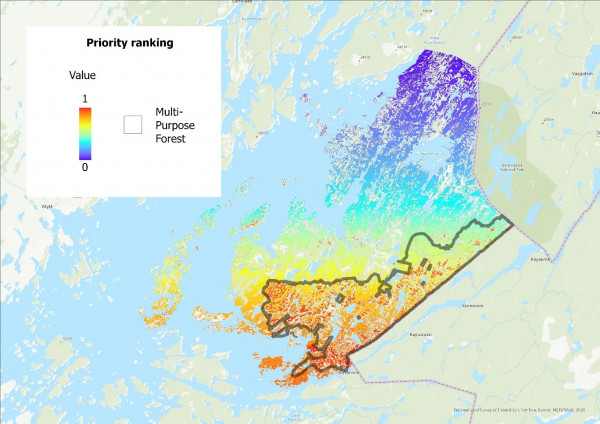
Figure 1.Map showing the results from the analysis for the 5 conflict generating factors. Priority ranking for these factors varies from 0 (no conflict generating factors) to 1 (high concentration of conflict generating factors).
The survey data revealed a few strong factors that contribute to conflict generation. The clearcut areas, which are highly concentrated in the state-owned multi-purpose forests, were seen as influential according to the survey (Figure 1). Additionally, clear-cut areas have significant effect on lack of older forests and fragmentation of old forest patches. Overlap between reindeer herding areas and state-owned forests was also seen as having a significant effect on the potential for conflict. Related to this, overlap between Sámi areas and state-owned forests were seen by the respondents as also having some impact on the potential for conflict. As a result, the conflict-related factors were concentrated in the multi-purpose forest areas in the south as opposed to protected areas in the north. This suggests that land use regime has a significant effect on the emergence of land use conflicts in the Paatsjoki area.
Research highlights
The study complements what prior research has indicated regarding the importance of governance regime on the landscape and emergence of land use conflicts (Horstkotte et. al. 2014). The survey confirms what has been found in previous surveys done with reindeer herding practitioners regarding the effects of forestry on reindeer herding, namely that fragmentation of older forests due to loggings and infrastructure damages the pastures (Turunen et. al. 2020).
This study indicates the importance of incorporating landscape composition factors when studying land use conflicts. Although Kyllönen et. al. (2006) highlighted the significance of considering both socio-economic factors in conjunction with “physical properties” of the conflict, large part of research on the subject has focused solely on governance and social political context. This study demonstrates how interaction between governance and the situation on the ground can be analysed by using survey data with land cover data.
The majority of studies do not address local context and understanding of land use conflicts on a local level, even though it is known that local perspectives and knowledge are important in terms of understanding land use conflicts between reindeer herders and forestry (Heikkinen et. al. 2010; De Plessis 2020). The local perspective is especially important in the context of land use conflicts between reindeer herding and forestry as the conflict areas are concentrated in areas with specific factors. This study demonstrates that SCP analysis, which is usually used in analysing areas for conservation, can also be utilized in analysing land-use conflicts. Using these methods enables identifying areas of particular interest from the perspective of different land users. It is especially useful for identifying areas where factors that raise risk of land use conflict overlap and how concentrated they are.
Concluding remarks
The study emphasizes the need for local-level, stakeholder-inclusive, and spatially informed approaches to better understand and manage conflicts between reindeer herding and forestry, while also integrating sustainability and governance perspectives. In the future more emphasis should be put on studying local land use conflict between reindeer herding and forestry from the perspective of variety of land use regimes, including private forestry areas. SCP analysis can be used to facilitate stakeholder dialogue in participatory processes by highlighting the most important areas in terms of conflict from the map.
References
De Plessis, Gitte (2020). Killing Reindeer: A Spatial Analysis of Nordic States and Nomadic Forms of Life in the Arctic. International Political Sociology, 14(4), 1-19.
Heikkinen, H., Sarkki, S., Jokinen, M., Fornander, D.E. (2010). Global area conservation ideals versus the local realities of reindeer herding in Northernmost Finland. International Journal of Business and Globalisation, 4(2), s. 110-130.
Horstkotte, T., Sandström, C., Moen, J. (2014). Exploring the Multiple Use of Boreal Landscapes in Northern Sweden: The Importance of Social-Ecological Diversity for Mobility and Flexibility. Human Ecology, 42(5), 671-682.
Kivinen, S., Moen, J., Berg, A., Eriksson, A. (2010). Effects of Modern Forest Management on Winter Grazing Resources for Reindeer in Sweden. Ambio, 39(4), 269-278.
Kyllönen, S., Colpaert, A., Heikkinen, H., Jokinen, M., Kumpula, J., Marttunen, M., Muje, K., Raitio, K. (2006). Conflict management as a means to the sustainable use of natural resources. Silva Fennica, 4(4), 687-728.
Moilanen, A., Kujala, H., Lehtinen, P., Kohonen, I., Jalkanen, J. (2025). Zonation 5. Retrieved 31.10.2025
https://zonationteam.github.io/Zonation5/credits.html
Peltonen, L., Kangasoja, J., Luoma, E., Turunen, J., Lahdenperä, S. (2020). Saamelaisten kotiseutualueen valtion metsien käytön ristiriidat ja ratkaisumahdollisuudet: konfliktikartoitus. Metsähallitus. Retrieved 31.10.2025 https://julkaisut.metsa.fi/assets/pdf/muut/Saamelaisten_kotiseutualueen_valtion_metsien.pdf
Reindeer Herders Association (2024). Paatsjoki. Retrieved 31.10.2025 https://paliskunnat.fi/reindeer-herders-association/cooperatives/cooperatives-info/paatsjoki/
Sandström, P., Cory, N., Svensson, J., Hedenås, H., Jougda, L. & Borchert, N. (2016). On the decline of ground lichen forests in the Swedish boreal landscape: Implications for reindeer husbandry and sustainable forest management. Ambio, 45(4), 415–429.
Turunen, M., Rasmus, S., Järvenpää, J., & Kivinen, S. (2020). Relations between forestry and reindeer husbandry in northern Finland – Perspectives of science and practice. Forest Ecology and Management, 457, 117677.
Biography of the authors
Severi Raja-Aho is a master of social sciences and graduate from Novia University of Applied Sciences Natural Resource Management masters program. He currently works as a country of origin researcher for the Finnish Immigration Service. His interests and expertise include intersections between natural resources, conflict resolution and participatory processes.
Dr. Fábio Balotari-Chiebáo is the supervisor of this thesis. He is a Senior Researcher and Lecturer from the Faculty of Bioeconomy at Novia. Fábio is an ecologist and conservation biologist with expertise in spatial ecology, GIS, environmental and biodiversity conservation and spatial planning. He has worked primarily on human-wildlife conflicts in the context of energy transition.
The blog post has been reviewed by Novia's editorial board and accepted for publication on 16.12.2025.
