What is the perceived level of Psychological Safety in an R&D organization?

Psychological safety, is the term just another buzzword or is it something that should be emphasized in the workplace? Modern organizations work in increasingly dynamic conditions, confronting greater uncertainty and complexity than ever before. To stay competitive in the high-risk environment, organizations are forced to pursue new ways for innovation and experimentation. An enabler for such an environment, where employees can freely contribute and challenge the status quo, is psychological safety. As a consequence, the interest in psychological safety has increased during recent years, both in work organizations and among researchers. But, what does psychological safety actually mean?
Professor Amy Edmondson, one of the key contributors within the research on psychological safety has defined it as “a climate where people feel safe enough to take interpersonal risks by speaking up and sharing concerns, questions, or ideas”. In other words, in a psychologically safe environment, people can be and express themselves. They feel comfortable speaking up, asking questions, sharing concerns, and admitting mistakes, without fear of humiliation, embarrassment or punishment. Psychological safety is however not about being nice, always getting your way, or lowering your performance standards.
It is suggested that psychological safety is the source of numerous positive outcomes, such as, learning, work performance, communication, and employee engagement. In addition, studies claim that it causes higher employee retention and promotes employee wellbeing related matters, which in turn results in better job satisfaction, and lower burnout rates.
In Risto Koivisto’s MBA thesis in Digital Business and Management, the psychological safety in an R&D organization in a global manufacturing and technology company was examined. The company is known for its highly innovative solutions, and it is also claimed that the company is the technology forerunner within the industries where it operates. For members in an R&D organization, feeling psychologically safe can be especially beneficial, as psychological safety has been proven to enhance innovation and creativity, which both are crucial elements for the success of R&D teams.
If the R&D organization is very innovative and psychological safety is good for creativity and innovation, then the level of psychological safety should be high, right? This is where the thesis steps in, as providing a clarification on the perceived level of psychological safety was the main objective of the thesis.
The following question, how can the level of psychological safety be determined? There are numerous measures to select from. The most widely used measure is a 7-item assessment called Psychological Safety Scale (PSS), developed and introduced by Edmondson in 1999. Since then, scholars have introduced numerous measures to assess the level of psychological safety, but the majority of measures are adaptations of Edmondson’s PSS.
In this thesis, Edmondson’s scale was selected, mainly due to its widespread use, which enables comparison with other studies. A survey was distributed and responses of each item were anchored with a 5-point Likert scale, ranging from strongly disagree to strongly agree, corresponding to 1 – 5 points. The figure below shows the mean of each item in the measure and PSS-score at the bottom, is the mean of all items, or better described, the level of perceived psychological safety within the teams in the R&D organization.
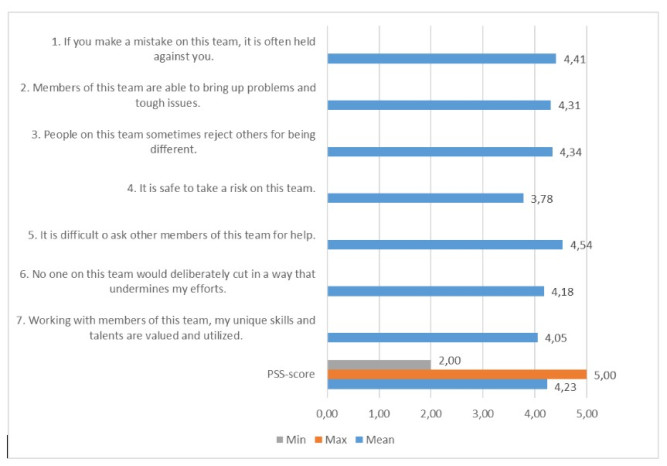
The assessment resulted in a PSS-score of 4.23. Well, on a 1 to 5 scale that seems like a good value, but how does that value compare to prior research?
A search was conducted, with the aim of finding studies using the identical measure to determine the level of psychological safety. Several studies were found, but not a single one with a PSS-score higher than in the assessment of the thesis. The highest score found was 4.12, which derived from a study of senior leadership team members conducted in 2022. Anyway, it is common that individuals with a higher status in an organization, perceive higher psychological safety. Also, it must be highlighted that PSS-scores from studies done in R&D teams, were found to be in the range of 3.84 – 3.25, which is significantly lower than the score in the thesis.
Reflecting on the comparison between the PSS-score from the thesis study and prior research, it is fair to claim that the perception of psychological safety in the R&D organization examined for the thesis, is at an exceptionally high level. Unfortunately, the thesis did not reveal what lays behind the innovative behaviour of the employees, but the remarkably good level of psychological safety could well be one of the contributors to the highly innovative climate.
Conclusion
What is then the perceived level of Psychological Safety in an R&D organization? A condensed answer based solely on the result from the thesis would be that the perceived level of psychological safety is exceptionally high in an R&D organization. However, if taking prior research conducted in other R&D organizations into consideration, the result is not consistent, and the answer is no longer as straightforward. Hence, a generalized answer to the title question would be that the perceived level of psychological safety is not uniform and can vary significantly between R&D organizations.
Further reading:
- Edmondson, A. C. (2018). The fearless organization: Creating psychological safety in the workplace for learning, innovation, and growth. John Wiley & Sons.
- Edmondson, A. C., & Bransby, D. P. (2023). Psychological safety comes of age: Observed themes in an established literature. Annual Review of Organizational Psychology and Organizational Behavior, 10(1), 55-78.
- https://doi.org/10.1146/annurev-orgpsych-120920-055217
- Koivisto, R. (2026). Perception of Psychological Safety - a Case Study of an R&D organization. MBA thesis, Novia University of Applied Sciences, Vaasa. https://urn.fi/URN:NBN:fi:amk-2026060522702
- Liu, Y., & Keller, R. T. (2021). How psychological safety impacts R&D project teams’ performance. Research-Technology Management, 64(2), 39-45. https://doi.org/10.1080/08956308.2021.1863111
Brief Biography

Risto Koivisto is the author of the post. He is an electrical automation engineer, with a true passion for leadership. For the past two decades he has worked in the R&D organization of a global technology and manufacturing company, combining the roles of a manager and a control system testing expert.

Rosmeriany Nahan-Suomela is one of the supervisors and Head of the Master’s Degree Program in Digital Business and Management at Novia UAS.
-----------------------------
The blog post has been reviewed by Novia's editorial board and accepted for publication on 27.8.2026.
Posta din kommentar