Prototyping the Future of Human Connection

Cover image: An Offline Moments pop-up, where visitors engaged with fun reflective questions designed to spark quick, low-pressure interaction.
Introduction
Sometimes a thesis begins with a question. Mustafa Al-Shihani’s thesis began with a feeling. He noticed that the rapid pace of modern life had led many students, teachers, team members, and cultural practitioners to describe the same feelings of exhaustion and disconnection, prompting a yearning for slower, more personal forms of connection. The purpose of Al-Shihani’s research was to investigate whether small, tangible objects could be used to anticipate the future of human connection.
Eventually, the project evolved into a formalized experimental process with a systematic exploration of what cultural interactions might look like through time, using designed artifacts as exploratory tools to experiment with cultural interactions, study new behaviors, and gather participant feedback. This exploration was grounded in the design practice of Tngl Studio, whose existing card-based tools were used within the thesis as tangible probes for studying how people slow down, reflect, and connect.
Tngl Studio, founded by Al-Shihani, is a Helsinki-based design studio, which utilizes an approach to reimagine human connections using simple, thought-provoking tools. The studio creates social card games and cultural experiences that facilitate natural connections, whether with friends, partners, team members, or two individuals meeting for the first time.
Research
Tngl Studio card decks, reflection prompts, and offline rituals were temporary invitations to briefly experience a different pace of life. Across the surveys, interviews, netnography, workshops, and pilot sessions Al-Shihani conducted, a recurring pattern appeared in the contexts studied: increased reflection and a stronger focus on interpersonal connections. In almost all cases, when individuals engaged with the minimal artifacts, the same sequential order occurred virtually every time; the pace of the room changed, reflection became possible, and focus turned away from screens and toward the people in the space. These observations were especially visible in classrooms and workshop settings, where participants navigated busy schedules and fragmented attention.
A teacher said, “This is the first time my class has taken a breath collectively.”
This is where the card format went beyond a design decision. The card is small, but it holds a great deal. It can externalize a thought, provide a pause in the momentum of a lesson or meeting, and redistribute power by giving equal access to all participants. In the thesis, Al-Shihani referred to the cards as forms of temporal architecture: physical prompts that structure dialogue without predetermining its course. They slow people down just enough to become aware of themselves and one another.
As the research progressed, the focus expanded from the individual to their context. Human-centered design is based on “what are the needs of an individual?” But life-centered design broadens this perspective to consider the needs of the relationships and systems surrounding the individual. Stakeholder mapping and foresight in the thesis identified schools, workplaces, and cultural organizations as key design actors that shape how people interact.
The following diagram introduces the conceptual intersection of strategic foresight, life-centered design, and human connection, which together frame the idea of “prototyping the future of human connection.
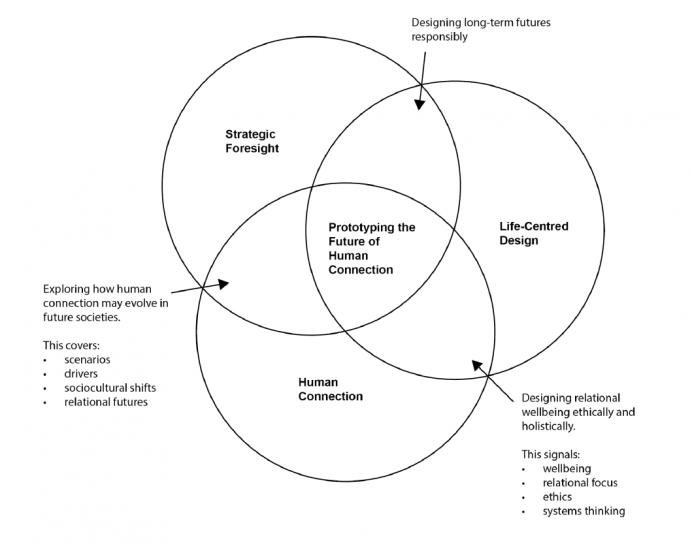
Picture 1. Conceptual Intersection of Strategic Foresight, Life-Centred Design, and Human Connection (see e.g. Pace, Bruno & Schwatz 2025)
Exploring Future Connections
Within the foresight phase, the scenarios described cities that incorporate “reflection commons” into their infrastructure. The education systems teach again emotional literacy, where recognition and awareness are treated as valuable resources.
Although some of these futures may seem like science fiction, they are grounded in real-world signals, such as a growing interest in mental well-being and the rising curiosity toward tactile, analog culture. This suggests that belonging can shift from something people privately feel to something society may collectively practice.
The Main Findings
One key finding was that producing tangible objects enables participants to experience the possibilities of their futures. When participants, for example, in the foresight workshops developed visions of connections in the year 2040 or 2080 through drawing, play, or performance, they were not merely creating a vision – they were momentarily experiencing it. This shift from speculation to experiential rehearsal made the future feel closer and more tangible. Thus, design can serve as a type of anticipatory practice – a means of responding to tomorrow’s values in today’s environments.
Together, these projects gradually formed an ongoing experiment that later crystallized into the design outcome of the thesis: Offline Moments.
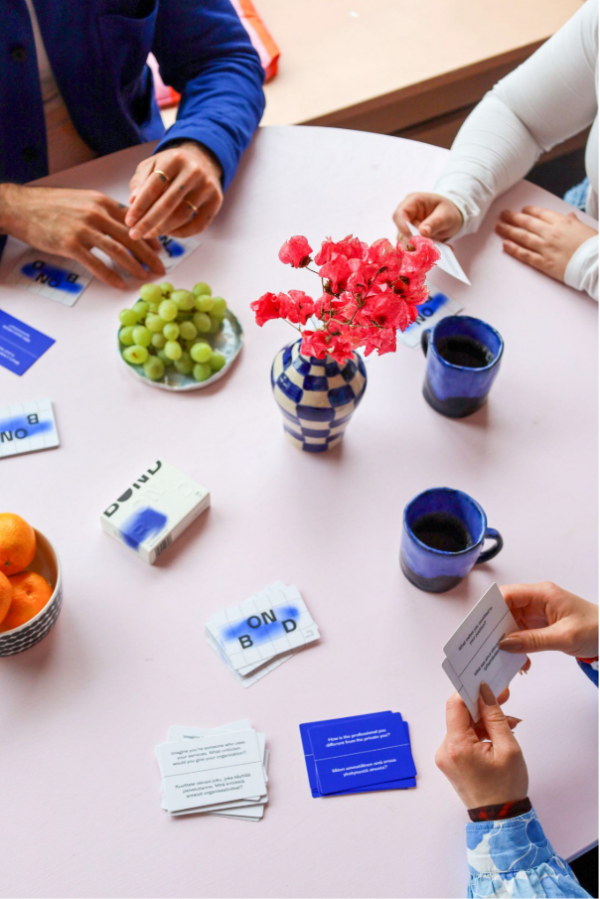
Tngl Studio card tools being used during facilitated offline interactions.
Offline Moments as Outcome
Offline Moments is a continually evolving experimental platform, where the ideas in the thesis can be tested in schools, museums, cultural institutions, and other organizations. In this thesis, Offline Moments were expressed through a set of small card-based prompts that created shared moments of slowing down and reflecting. Offline Moments transforms the process of envisioning the future into repetitive rituals – through small cards with guiding prompts and pauses to reflect together – which can be placed into everyday calendars and schedules. The pilot tests demonstrate positive changes in group dynamics, deeper levels of discussion, and a consistent interest in continuing to use the artifacts, once they become part of a habit.
As the outcome of the thesis, Offline Moments became more clearly articulated as the cultural unit within Tngl Studio’s ecosystem, positioned alongside the Studio and the Lab to carry the research into real-world contexts.
Conclusion
For Al-Shihani, completing the thesis marks a direction, not an ending point. The thesis suggests that in the future, design will not be primarily influenced by new technologies or rapid innovation; rather, it will be shaped by how well design creates situations that foster a meaningful human existence. The language of foresight offers a long-term perspective, while the ethics of life-centered design provide a framework for living within that perspective. This section reinforces the conceptual framework introduced earlier, creating a bridge between academic research and Tngl Studio’s ongoing practice. The study’s outcomes also point toward a larger possibility: that future societies might treat belonging not merely as a feeling but as a form of shared infrastructure.
Acknowledgements
This blog post is based on Mustafa Al-Shishani’s Master’s Thesis at Novia University of Applied Sciences. He thanks his supervisor, Dr Reija Anckar, and all participating schools, institutions, and contributors.
About the Author
Mustafa Alshihani is a designer and founder of BelongHub and Tngl Studio, creating frameworks, tools, and experiences that support human connection and belonging across schools, workplaces, and cultural settings. Tngl ecosystem – relationships between Tngl Studio, Tngl Lab, and Offline Moments.
References
Al-Shihani, Mustafa 2025. Prototyping the Future of Human Connection. MBA thesis. Novia University of Applied Sciences, Turku.
Pace, L.A. & Bruno, B. & Schwarz, L. O. 2025. Personas in scenario building: Integrating human-centred design methods in foresight. Futures,Volume 166, 2025,103539,ISSN 0016-3287, https://doi.org/10.1016/j.futures.2025.103539
The blog post has been reviewed by Novia's editorial board and accepted for publication on 15.12.2025.

Posta din kommentar