
Enhancing an Entrepreneurial Mindset among Zambian Engineering Students

The world today is characterised by what has been referred to as “VUCA (volatile, uncertain, complex, ambiguous) and no economy nor organisation is safe from disruptions (Major & Clarke, 2021). At an individual level, the VUCA phenomenon results in that people must focus on continuous learning, being adaptable and prepared for layoffs that can end a career abruptly (Lectera, 2025). Adapting to and learning an entrepreneurial mindset has been identified as a potential solution to cope with the disruptive economy. A fact is, that a disruptive economy offers huge potential for innovation and entrepreneurship (Peschl et al., 2021).
An entrepreneurial mindset (EM) is related to the question why some people recognize opportunities and others do not (Nematollah et al., 2025). EM has been described as a proactive behaviour towards entrepreneurship (De la Gala-Velásquez et al., 2024), incorporating skills such as a capacity to innovate and to cope with uncertainty and attitudes, such as a risk tolerance and optimism (Garbarino et al., 2024). As an entrepreneurial mindset is a pre-requisite for entrepreneurship, also universities have a significant role in developing curriculum and course content supporting an entrepreneurial mindset (Anckar et al., 2023; De la Gala-Velásquez et al., 2024).
Strengthening the entrepreneurial mindset of Zambian engineering students
The Sustainable Entrepreneurship in Engineering and Business (SEEB) project is a collaborative initiative between Novia University of Applied Sciences (Novia UAS) in Finland and the Copperbelt University (CBU) in Zambia. This project aims to enhance the entrepreneurial skills of engineering students and develop innovative solutions to societal challenges, particularly in waste management (Novia, 2025). Even if Zambia’s entrepreneurial ecosystem is growing, and even characterised as dynamic, many entrepreneurs in Zambia face challenges with the unstable regulatory environment and limited access to financing (Ngari, 2023) . According to a recent study, conducted among university students, the main barriers to entrepreneurship identified, comprised lack of capital, limited governmental support, inadequate managerial skills, taxation challenges, lack of confidence, and deficient entrepreneurship skills.
The SEEB project aims to transfer the Novia way of enhancing an entrepreneurial mindset and skills to the partner, Copperbelt University, in Zambia. In the first step of the project, a delegation of six students and three professors had the possibility to visit Novia campuses in Turku and Vaasa. During the visit, they were introduced to how the teachers at Novia’s degree program in Business Administration work to enhance entrepreneurial competence. From a student perspective, transformative pedagogy results not only in increased knowledge, but in transformative learning. Through transformative learning, students learn to challenge their own assumptions to develop new ways of viewing themselves, other people and the world. One of the goals is to develop students’ ability to cope with and adapt to a changing world. (Fleming, 2019 originally by Mezirow 1990).
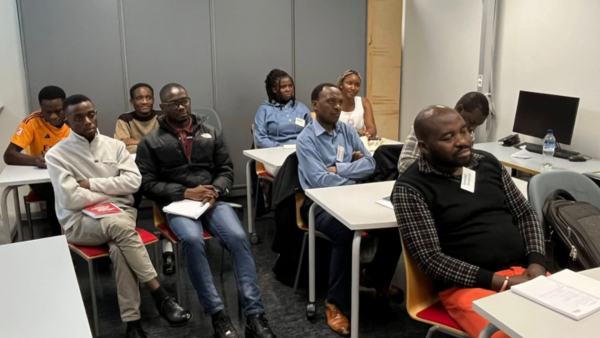
The Novia way to enhance entrepreneurial skills
Business students at Novia University of Applied Sciences develop an entrepreneurial mindset and tools throughout their studies. The learning approach starts from transformative pedagogy and in accordance with a social constructivist view, the learning is implemented through team-learning. From a student perspective, entrepreneurial competencies and business skills, are developed using the tools of the LOOPA method (Drivhuset, nd). Drivhuset's LOOPA method is about developing and testing business ideas in a cycle or "loop" of customer focus, testing and adaptation. The method combines theoretical innovation tools to develop products and services that are tailored to customer needs. The focus is on understanding the target group, its problems and needs by iterating and creating together. The final aim is to come up with a co-created value proposition that adds value for the target group. Proven tools such as the Value Proposition Canvas and Business Model Canvas are used for business development to build and visualise business models. The goal is to reduce uncertainty and increase the possibility that the business idea turns out to be successful. The LOOPA method helps to visualise and systematise innovation processes, which makes it a structured process for innovation and entrepreneurship education.
Next steps in the SEEB project
Entrepreneurship as a potential career was discussed among Zambian and Finnish students in a workshop during the visit of the Zambian delegation to Turku. It became clear, that Finnish students perceived entrepreneurship as a potential career more likely than the Zambian students. From a Zambian perspective, lack of funding possibilities and a vague understanding of what it means to be an entrepreneur contribute to the limited interest in setting up a business. One of the main activities of the SEEB project, a course “Entrepreneurship for Engineers” will start in January 2026. During the course the Zambian students will hopefully develop their entrepreneurial mindset and through a “Loopa” process, gain practical skills needed to develop a business concept.
The final activity of the project is a trip to Zambia to participate in an innovation camp organised in Lusaka. From Novia, six students have been given the possibility to travel to Zambia for 10 days. First, the Finnish delegation will visit Copperbelt University in northern Zambia, whereafter the trip continues to Lusaka and the innovation camp. During the innovation camp Finnish and Zambian students will work with sustainability challenges identified by Zambian organisations.
Conclusion
So far, the SEEB project has proceeded according to plans. The next step, to implement an online course about entrepreneurship is exciting in many ways. Do engineering students perceive entrepreneurship as an interesting career path and will thereby be motivated to actively learn and develop an entrepreneurial mindset? The digital solutions needed for implementation cause some excitements as well, do we manage to run the online classes without disruptions? The internet network in Zambia is not at Finnish levels, and they are used to different tools than those we usually rely on in Finland.
The big final of the project, our trip to Zambia, is something we really look forward to. The visit to the Zambian universities will deepen our understanding of the teaching and learning at Zambian higher education institutes and the innovation camp will challenge us to help solving urgent societal problems.
Sources
Anckar, R., Holmberg, E., Konttinen, A. & Ritalahti, J. (2023). Encore: enhancing
entrepreneurial mindset in Asia. AMK-lehti/UAS Journal 1/2023. https://uasjournal.fi/1-2023/encore-enhancing-entrepreneurial-mindset-in-asia/
De la Gala-Velásquez, B., Hurtado-Palomino, A., Monrroy-Villena,A. Gomez-Villegas, O. (2024). Roots of the entrepreneurial mindset in university students, The International Journal of Management Education, 22 (3), https://doi.org/10.1016/j.ijme.2024.101049
Drivhuset (nd). The Loopa Method. https://drivhuset.se/en/utbildning/vara-metoder/
Fleming, T. (2019). Mezirow and the theory of transformative learning. In V. Wang, (Ed.), Critical Theory and Transformative Learning, (pp. 120-136). IGI Global
Garbarino, L., Martinez, M., Seifried, C. S. & Barefoot, M. (2025). Entrepreneurial mindset education: Perspectives and applicability to the sport management curriculum, Journal of Hospitality, Leisure, Sport & Tourism Education, 37, https://doi.org/10.1016/j.jhlste.2025.100577
Nematollah, S., Khoshmaram, M., Mehdizadeh, H., Sadraei,R., Ayoubi, R. (2025). How is the entrepreneurial mindset of university students formed? The role of entrepreneurial inspiration, education, methods, and environment. The International Journal of Management Education,23 (2), https://doi.org/10.1016/j.ijme.2025.101158
Ngari, W. (2023). Rise of Zambia’s entrepreneurship landscape. https://growthafrica.com/rise-of-zambias-entrepreneurship-landscape/
Novia (2025). Sustainable Entrepreneurship in Engineering and Business. https://www.novia.fi/en/rdi/our-projects/sustainable-entrepreneurship-in-engineering-and-business#:~:text=The%20Sustainable%20Entrepreneurship%20in%20Engineering%20and%20Business%20%28SEEB%29,Finland%20and%20the%20Copperbelt%20University%20%28CBU%29%20in%20Zambia

Peschl, H., Deng, C., & Larson, N. (2021). Entrepreneurial thinking: A signature pedagogy for an uncertain 21st century. International Journal of Management Education, 19(1), 100427. https://doi.org/10.1016/j.ijme.2020.100427
Texten har granskats och godkänts av Novias redaktionsråd 9.12.2025.

Posta din kommentar