Why business cases cannot be considered as a one-off, self-centered effort

If you have ever been asked to prepare a business case, you know how challenging the task can be: retrieving data to support your business proposal and document it to build a solid argument is a complex endeavour which normally does not put on pause your other obligations.
Doing the work superficially is tempting but can backfire. The business case might be rejected and you will never see it realize or your business case might be approved with two possible outcomes: everything could work out somehow or, much worse and more likely, the whole organization will put their sweat and tears on something that never had any chance to succeed.
Statistics in New Product Developments are against you: only one out of 7 new product ideas make it to the market and of these only 60% succeed commercially. The reasons of such low success rates are routed back mainly to either weak front-end homework (the business case!) or to too many projects in the pipeline. (Cooper, 2017)
So, skip the business case effort at your own peril.
But what precisely is a business case and how to prepare a good one, then?
Business cases can be defined as structured documents or presentations which justify the initiation (or continuation!) of a project or investment. They provide decision makers with the necessary information to decide whether to pursue an initiative.
You can find many business books explaining all the tricks and tools to prepare a good document. The research of Kinnunen (Kinnunen Tuomo, 2011) provides a good framework which considers all the important aspects a business case should cover and the book of Marshall (Business cases that get results, 2019) reveals, in a succint but effective way, how to structure it.
However, many authors miss some important points:
- A business case can be exceptional but totally irrelevant for a company or not practical due to priorities or other constraints;
- There is not only one decision to be made.
Business cases must be put in context and evaluated against other initiatives which fight for the same resources. It is not possible to pursue all the initiatives: trade-offs are required.
After greenlight is given to proceed, the decision should be periodically re-evaluated and the business case must be followed-up. Investing in new products is a betting game: when the risks are high you need to keep your bets low, and when the risks are low you can increase your stakes. Like for a poker game the trick is to know when to hold, when to fold and when to walk away.
Sure, re-evaluating a business case too often is counterproductive but there is need for a clear process which provides a methodical timing to re-assess the decisions made in the light of new information available.
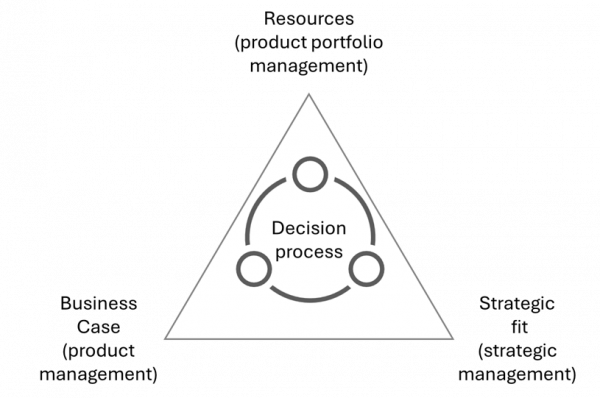
So, what are the key elements and the key stakeholders for a successful business case decision? They are summarized in the following picture:
-
Large organization must have a decision process in place. The stage-gate model is a recognized standard for manufacturing industries and is the advised model to follow.
-
The general management must provide clarity around the company’s strategy and a tool or process must be in palce to evaluate the strategic fitness of a business proposal.
-
The business case documents must be prepared thoroughly and must emphasize the market needs, the technical feasibility, the strategic fitness, the market value and, last, the financial analysis. Product management functions are in charge of this endeavour.
-
Each initiative must be put in perspective. Implications to other products and initiatives, as well as to the available resources, must be considered. Product Portfolio Management (PPM) functions should cover this part.
For further reading:
Cooper, R. G. (2017). Winning at New Products: Accelerating the Process From Idea to Launch (3rd ed.). New York: Basic books.
Kinnunen Tuomo, P. A. (2011, February). Business case analysis in new product development. Global Journal of Management And Business Research, 11(2).
Marshall, C. (2019). Business cases that get results. BCS, the chartered institute for IT.
Short biography of the Author:

Piero Zoglia is the author. With a mechanical engineering background He has been working as a Manager in the fields of product management and sales support since 2012. He is currently leading a product management team at Wärtsilä Finland Oy where He manages a portfolio of products related to storage and process of alternative fuels for marine applications.
Posta din kommentar