
Nettle in natural resources and design education

Project interns Ganga and Richard measuring nettles. Photo: Ulrika Dahlberg
The NyNässla project produces information on using nettle in multiple ways, mainly for food and fibre, but also for other applications. The project has involved agriculture, Sustainable Coastal Management and Natural Resource Management students both through group work and internships. The students have collected data from the field, participated through thesis work and gathered information about current businesses using nettle both in Finland and aborad.
In agricultural education, nettle- if regarded -is mostly addressed as a weed due to its unusualness as a production crop. This means the topic is often new to both students and teachers. In textile and design education, on the other hand, the interest in new and traditionally used biomasses and fibres is growing. For example, at Aalto University in Finland and VIA University in Denmark, natural materials and plant fibres are widely experimented with, and nettle fibre is not unknown to the education programmes. VIA works with the whole supply chain of hemp, from cultivation, harvesting, processing, and extraction of hemp fibres to practical production, spinning, weaving, and knitting of fabrics. At Aalto, nettle has been emerging almost annually through interest from students and experiments in material courses. At the Royal Danish Academy, European nettle has been included in textiles fibre related exhibition and scope of study among other native fibre plants such as hemp and flax. As a result, an innovation project is ongoing until 2027.
In Natural Resources education with a focus on using what’s in the wild, nettle usually has an established role. At Livia College at Campus Tuorla in Southwestern Finland the gardening education has experimented with growing nettles in a greenhouse and planting them outside in a utility garden. The education programme for Natural Resources Producers has used the cultivated nettles for food processing, although mostly using wild plants.
When we visited Livia in the springtime, teacher Päivi Lehtonen and her students prepared a meal for us including nettle in many ways. We had oat chips with potato-nettle filling, nettle tortilla with wild herbs filling, nettle pesto and crispbread with hemp and nettle seeds and kombucha with nettle. For dessert we had ice cream with spruce tip syrup. The students told us they enrolled in the education programme, because they are interested wild plants, want to learn how to use what is available in the wild, without harming nature, and to use locally available raw materials with high nutritional values. This also relates to learning survival skills.
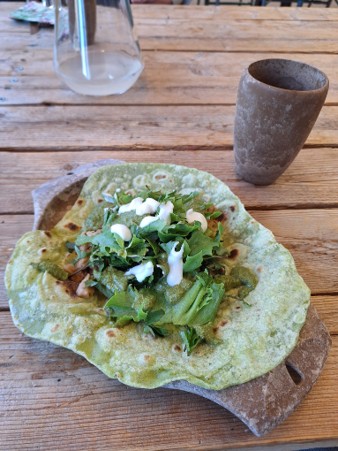
Nettle tortilla with wild herb filling. Photo: Ulrika Dahlberg
The teacher and the students conclude that the areas for collecting wild nettle are fragmented in Southern Finland, due to a lack of large, uniform publicly accessible natural areas. Hence, the margins of organic fields can be good places to collect nettle and other wild plants. Some Finnish businesses nevertheless prefer to buy ready chopped nettle from abroad, to smoothen the manufacturing process of their products. Readily processed Finnish nettle is not available in larger scale at the moment. Interestingly, also visible from the nettle menu prepared at Livia; nettle can, has been and is used as a "drop in" material in already existing applications – such as tortillas.
Also, among the general public there is an interest in learning more about nettle. Many Finns know how to use wild nettle in soups and other foods, but fibre use is less known. In spring nettle's food and fibre use was covered (in Finnish) at a nettle lecture at Gastronomic Food Club. Päivi Lehtonen from Livia talked about identifying nettle in the wild and what to expect from the nutrient values of nettle. Päivi had a good idea of which foods it can be used for: salad, pesto, seasoning, broths and stocks (adding not only colour but also a green, slightly fish-like aroma), smoothies, puréed soups, warm vegetable side dishes, deep-fried preparations, chips, mead, kombucha, fermented ginger drinks... all familiar dishes and you name it. Samica from our own NyNässla project continued by talking more about the fibres side of nettle. The beneficial properties of nettle fibre include its lightness, strength, lustre, moisture resistance, and breathability, but the final quality and yield depends on the nettle variety, growing conditions, and processing methods- all closely linked to agriculture! Nettle’s versatile use can make the amount of information confusing – so many uses and so many perspectives.
To conclude, education and information about nettle will be in demand also in the future, especially in times when self-sufficiency is a trend. A crop with many areas of use and available to everyone keeps inspiring new people both through historical uses and more modern experiments. Use of nettle requires knowledge and education from multiple fields: how to farm or collect, how to process for food, feed, fibre or cosmetics, how to design products and so on. A perfect topic for a collaboration project!
The project NyNässla – Nettle for fibre and food in Uusimaa is carried out in collaboration with Nylands Svenska Lantbrukssällskap at Västankvarn research farm. Funding has been granted from the European Union, via the Economic Development Centre in Uusimaa, Svenska kulturfonden and Stiftelsen Finlandssvenska Jordfonden.
Texten har granskats och godkänts av Novias redaktionsråd 9.10.2026
