
30,000 tiny creatures and a slightly confused AI

Plankton research has traditionally relied on time-consuming microscopy, but recent advances in imaging and artificial intelligence (AI) are rapidly changing how we study these microscopic communities. In our current research, we combine automated imaging, AI-based classification, and expert validation to better understand plankton composition and abundance.
The process begins with a small water sample of a few millilitres from the experimental units. Within that small volume, there’s an entire hidden world of plankton. Samples can also be collected from the field. To explore it, we use a device called a PlanktoScope (Pollina et al. 2022). The PlanktoScope is essentially a compact, automated microscope. Instead of placing a sample on a slide and observing it manually, the water is pumped through a narrow channel called a flow cell. As particles and organisms pass through, a camera continuously captures images of organisms and particles between 20 and 200µm in size. Within a short time, the instrument produces thousands of high-resolution images of live plankton, providing a detailed snapshot of the plankton community.
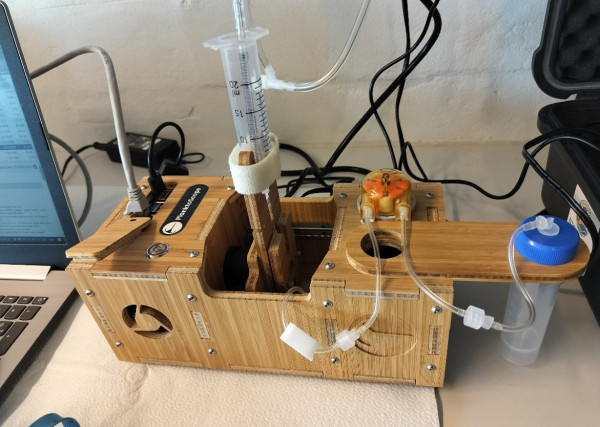
PlanktoScope capturing microscopic life from water. Photo: Jonna Engström-Öst
The images are uploaded to EcoTaxa, an online platform that organizes and stores image datasets along with associated metadata such as sampling date and treatment. EcoTaxa also applies machine learning algorithms to suggest taxonomic classifications for each image. In principle, this greatly accelerates the analysis process. However, in practice, the system is far from fully automated.
A helpful but overconfident assistant
AI is a useful tool, it helps us handle large amounts of data, but it cannot replace careful observation and knowledge. Instead, it works best as a support, providing suggestions that researchers then confirm or reject. Although AI performs well for organisms with clear and distinct morphological features, such as zooplankton or larger phytoplankton, it is less reliable for smaller or more ambiguous taxa. It is like working with a very fast, but sometimes slightly overconfident assistant who tries to name everything it observes, although it can sometimes sound more confident than it should be. The errors highlight a key limitation: the algorithm will always attempt a classification, even when confidence is low. As a result, expert validation remains essential.
In our study, we are currently working with a dataset of more than 30,000 images, manually verifying and correcting the AI-generated classifications. This process is both demanding and rewarding. Over time, it becomes easier to recognize recurring morphologies and distinguish between similar taxa. At the same time, the variability within plankton groups means that some images remain challenging and require careful interpretation. Sometimes the organism is partially visible, rotated in an unusual way, or simply too tiny to identify with confidence. This introduces a potential bias in the dataset. For this reason, we also combine it with traditional microscopy, which allows for higher magnification and more detailed examination of small cells. In that sense, the old and new approaches complement each other well.
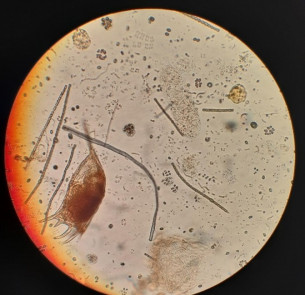
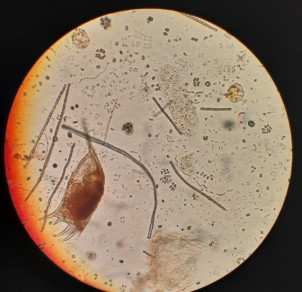
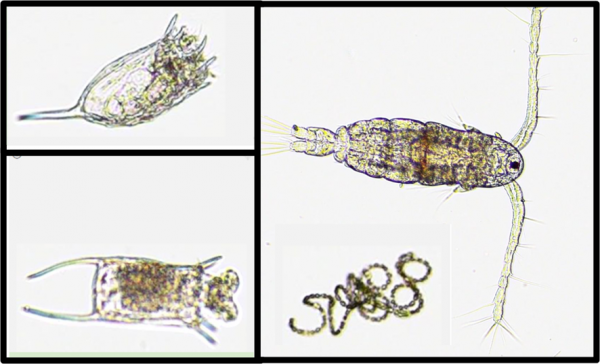
Plankton sample seen though a traditional microscope (top) and images of zooplankton taken with the PlanktoScope; rotifer Keratella sp. (left), and a crustacean and cyanobacteria filament (right).
Despite these challenges, the combined approach offers clear advantages. Automated imaging allows for the rapid processing of several samples, while AI-assisted classification provides an efficient starting point for data analysis.
From a research perspective, one of the most valuable aspects of this workflow is the ability to generate a high-resolution overview of community composition in a relatively short time. This is particularly useful in experimental settings or large-scale monitoring programs, where manual analysis alone would be too slow. Ultimately, combining automated imaging, AI-based classification, and human validation offers a balanced and effective approach to plankton analysis. And perhaps most importantly, it reveals how much diversity exists within even a single drop of water, reminding us that even the smallest components of ecosystems are both complex and scientifically intriguing.
AI in science: a tool, not a replacement
Working with this system provides an important reminder about the current role of artificial intelligence in scientific research. AI is not a replacement for expertise but rather a tool that can enhance and support it. Its effectiveness depends strongly on the type of organisms being analysed, the quality of the images, and the availability of well-annotated training data.
This work has shown me how important human expertise still is. It is not about replacing scientists; it is about giving us better tools to explore complex systems. AI can process data quickly, but it lacks context, judgement, and ecological understanding. It does not recognise when something is visually implausible. It does not question its own assumptions. That responsibility still belongs to us. At the same time, human input improves the system. Every corrected classification becomes part of better training data, which can make future models more accurate. In that sense, the relationship between AI and researchers is not competitive, it is collaborative.
Technology like the PlanktoScope and EcoTaxa does not take away from the scientific process but enhances it. It allows us to work with larger datasets, and explore systems that were previously too complex to analyse in detail. At the same time, it reminds us that tools are only as effective as the user's skill.
References
Pollina, T., Larson, A. G., Lombard, F., Li, H., Le Guen, D., Colin, S., ... & Prakash, M. (2022). PlanktoScope: affordable modular quantitative imaging platform for citizen oceanography. Frontiers in Marine Science, 9, 949428.
Texten har granskats och godkänts av Novias redaktionsråd 11.6.2026